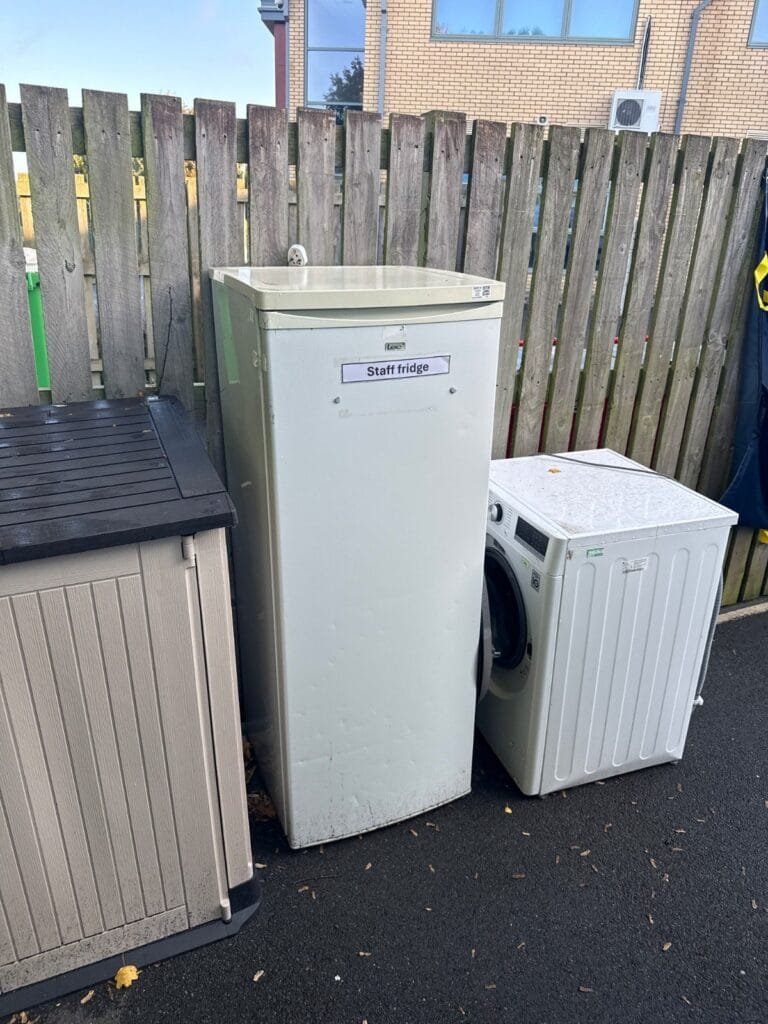

How to Get Rid of a Fridge in Leeds: Legal Ways
Short answer, in order of cost:
- Free. Drive it to a Leeds tip (HWRC) yourself, if you have a vehicle and someone to help lift it.
- Free. Book Leeds City Council’s free annual bulky item collection, if you can get it to the kerb and wait.
- Free. Ask the retailer to take the old one when the new one is delivered. Most will, if you ask when you order.
- From £60. A licensed collection like Kruze. We carry it out, degas it properly and give you the paperwork.
- Never. A skip. A fridge cannot legally go in one, and no legitimate skip firm will take it.
- Never. The kerb. Leaving a fridge outside your house is fly-tipping, and it is your name on it.
Fridges are the one household item where the law genuinely is different, and almost nobody knows why. Here is the whole thing, plainly.
Why a fridge is not just a big heavy box
A fridge or freezer containing CFCs, HCFCs or HFCs is classified as hazardous waste. That is not a technicality invented by the waste industry to charge you more. It is because of what is inside.
The Environment Agency’s own line is that fridges and freezers made before 1995 typically contain CFC and HCFC refrigerants and blowing agents, in the cooling circuit and, crucially, blown into the insulation foam in the walls and door. Newer ones use hydrocarbons or HFCs instead. Either way, the gas has to come out under controlled conditions, and the foam has to be shredded in a sealed system so nothing escapes.
The relevant rules sit across the Ozone-Depleting Substances Regulations 2015, the F-gas rules, and the WEEE Regulations 2013, which together send fridges to an approved authorised treatment facility rather than into general waste.
The bit that matters most for you is the F-gas rule. It is against the law to work with F gas without the correct qualifications, and a qualified technician must recover the gas from equipment at the end of its life. Deliberately venting it to the atmosphere is an offence in itself. The recovered gas, or the whole unit, then has to go to a licensed facility via a registered waste carrier. So this is not a job for you, your mate with a van, or anyone offering to “sort the gas out” on your driveway.
The practical consequence for you is short: a fridge cannot go in a skip, cannot go in a general van load without a proper route, and cannot go in the bin. It has to go to a site that can degas it, and the carrier moving it has to be licensed.
Option 1: The tip (free)
If you have a van or an estate car, a second pair of hands, and a free morning, this is genuinely the cheapest way to get rid of a fridge in Leeds. Leeds household waste recycling centres normally accept fridges and freezers, free, if you live inside the Leeds City Council boundary. Right now they are not taking them at all. The council has temporarily suspended fridge and freezer drop offs at every site because of a national shortage of specialist processing facilities, and our Leeds tip opening times guide tracks that notice and what each of the eight sites takes. There are eight sites: Kirkstall, Meanwood, Middleton, Otley, Pudsey, Seacroft, Wetherby and Yeadon.
The catches are real and worth knowing before you load up. It will not fit in a normal car (an under-counter fridge might, a tall fridge-freezer will not). Vans and trailers need a permit applied for in advance, and only a short wheelbase low roof van under 3 tonnes even qualifies, so turn up in a hired high roof van and you will be turned away at the barrier whether you have a permit or not. There is also a 6ft 6in (2.0m) height restriction at the entrance. It is heavier than you think and it has no good handholds, so it is an awkward two-person lift. And at a weekend, budget half a day rather than half an hour.
Best for: under-counter fridges, people with a van, people with a helper. Bad for: tall fridge-freezers, flats above ground level, anyone on their own.
If you can do this, do it. It is free and it beats paying us.
Option 2: The council’s free bulky collection (free)
Leeds City Council gives most households one free bulky item collection per financial year, with up to five items per booking, and households on council tax support get up to four free collections a year. Electrical appliances are on the accepted list, and nothing can be larger than 6ft x 4ft, which a domestic fridge-freezer comfortably is not. Additional collections are £30 each, up to three a year. You will need your council tax account number to book, and you can book up to four weeks ahead.
For a fridge this is excellent value. It is free, it is legal, and the council’s contractor handles the degassing properly.
The two catches:
You wait. Slots can be weeks out. If you have a new fridge arriving on Thursday and the old one is still in the kitchen, this route does not solve your Thursday.
You carry it out yourself. The collection point is your kerbside or an agreed access point. The council crew is not coming into your kitchen, disconnecting anything, or bringing it down your stairs. That is on you.
If you can lift it, wait for it, and book it, use this before you pay anyone. Including us.
Option 3: Retailer takeback when the new one arrives (free)
Ask when you order, not when they arrive. Under the WEEE rules, retailers selling new electrical equipment must offer to take back old equipment of the same type or function, whether you buy in store, online or by mail order. In store that service has to be free. For collection from your home, they are allowed to charge to cover transport.
Two catches, and the first one surprises people. A retailer can comply by joining the Distributor Take back Scheme instead of taking your old appliance, which means the answer may simply be that they fund recycling centres and you take it to the tip yourself. So ask before you buy, not after.
The second is that where they do collect, it is almost always a same-day, at-the-door arrangement. It has to be disconnected, defrosted, emptied and standing ready when the driver knocks. If they cannot take it in the same trip, they will not come back for it.
Best for: anyone buying a replacement. Bad for: a fridge that has been dead in the garage for two years.
Option 4: Licensed collection (from £60)
This is what we do, so weigh the section accordingly.
Kruze fridge and freezer disposal starts from £60. That is inclusive of our labour, the licensed disposal route, and a waste transfer note as proof it was handled legally.
What the £60 actually buys is the three things the free options do not give you. No lifting, because a two-man team disconnects it and carries it out of the kitchen, down the stairs and through the side gate. No waiting, usually same day or next day rather than a slot in three weeks. And paperwork, meaning a digital waste transfer note with your name on it showing where the appliance went and that the carrier moving it was licensed.
Honesty time. If your fridge is on the ground floor, you own a van, and you have a free Saturday, the tip is free and it beats us, once the Leeds centres are taking fridges again. If your free annual council collection is unused and you are not in a hurry, use that instead. Genuinely. The £60 is for people who cannot lift it, cannot transport it, or need it gone this week.
Freezers, chest freezers and American fridge-freezers
Freezers and chest freezers are the same legal category as fridges. Same gases, same degassing requirement, same £60 starting price. Defrost it first if you possibly can, because a freezer full of meltwater is a heavier lift and it will leak in the van and across your floor.
American-style fridge-freezers are the ones people underestimate. They are wide, they are heavy, and they very often do not fit back out through the door frame they came in through, because they were carried in before the kitchen was fitted. These are always a two-man job and sometimes a doors-off job. Send us a photo and the door width and we will price it properly before we turn up, rather than surprising you on the day.
Integrated fridges need uninstalling from the unit and are not a lift-and-go item, so tell us in advance. Commercial fridges and display chillers are a different beast again and are quoted individually.
Commercial fridges, display chillers and catering freezers
The short answer for a business in Leeds: a commercial fridge cannot go to a council tip or on the council’s bulky collection, because it is business waste, and it is also hazardous waste because of the refrigerant gas and the insulating foam. A plug-in unit (bottle cooler, under-counter fridge, upright display chiller, chest or ice cream freezer) can be collected whole by a registered waste carrier, with a consignment note rather than an ordinary waste transfer note. A built-in system with the compressor outside or on the roof, such as a cold room or a walk-in freezer, needs an F-gas certified refrigeration engineer to recover the gas before anyone takes it apart. Everything below explains which of those you have and what you have to keep on file afterwards.
Why a business fridge is treated differently from the one in your kitchen
Two rules stack on top of each other. The first is that it is business waste. GOV.UK says any waste that comes from a commercial activity is business waste, including waste from the part of your home you use to run a business. Leeds City Council goes further and says waste from business, retail or commercial premises, landlords and tradespeople cannot go to a household waste recycling centre at all, and that bringing trade waste can mean a fine or a prison sentence. So the café, the corner shop, the office kitchen and the landlord clearing a rented flat are all in the same position. The tip is not an option, whatever the tips are doing about fridges this month.
The second rule is that a fridge is hazardous waste. GOV.UK’s hazardous waste guidance uses fridges as its example of equipment containing ozone depleting substances. That changes the paperwork. Ordinary business waste moves on a waste transfer note. Hazardous waste moves on a consignment note, which stays with the unit until it reaches the treatment site.
| What you are getting rid of | How it is classed | Paperwork | How long the business keeps it |
|---|---|---|---|
| Plug-in commercial fridge, display chiller, bottle cooler, chest or ice cream freezer | Business waste, hazardous | Consignment note. You fill in parts A and B, keep one copy and hand two to the carrier | 3 years, as part of your register |
| Shelving, racking, counters, cardboard and other non-electrical fit-out | Business waste, non-hazardous | Waste transfer note, or an invoice carrying the same information | 2 years |
| Cold room, walk-in freezer or multideck chiller with a remote compressor | Refrigerant must be recovered on site first | The engineer recovering the gas must hold the right F-gas certificate. The cabinets then follow the rows above | As above, once the gas is out |
Plug-in or remote? The question that decides who you call first
A plug-in unit has its compressor built into the cabinet and runs off a normal socket. Almost everything in a café, a pub back bar, a takeaway or a convenience store is this kind: the glass-door drinks fridge, the under-counter prep fridge, the upright display chiller, the chest freezer and the ice cream freezer by the till. The gas circuit is sealed and stays sealed. The unit travels whole to a permitted treatment facility, where the refrigerant and the foam are dealt with, exactly as a household fridge is. Nobody needs to cut into it on your premises, and this is the kind of unit we collect.
A remote or split system has the compressor somewhere else, usually on an outside wall or the roof, joined to the cabinet by copper pipework. Cold rooms, walk-in freezers and the long open multideck chillers in larger shops are usually built this way. To take one out, somebody has to break into the refrigeration circuit. GOV.UK is clear that recovering the gas and decommissioning an old system both need an individual F-gas qualification, and that working without one can bring a civil penalty.
We are not refrigeration engineers and we do not break into gas circuits. If you have a remote system, your first call is an F-gas certified refrigeration contractor, often the company that services your equipment now. Once they have recovered the gas and disconnected the pipework, the cabinets, panels, shelving and the rest of the strip-out are ordinary heavy collection work, and that part we can do. Anyone who offers to just cut the pipes and take it is offering to vent refrigerant illegally on your premises, and the duty of care for what happens to your waste stays with you.
Check these before anyone collects it
- Switch it off a day ahead if it is a freezer, and leave the door propped open with a tray underneath. A freezer full of meltwater leaks across the floor and the van.
- Empty it completely. Stock left inside becomes food waste, which is a separate stream.
- Read the rating plate. It is usually inside the door or on the back, and it names the refrigerant. Photograph it along with the whole unit.
- Measure the route out. Upright display chillers are often around two metres tall and heavier than they look. Note any steps, a cellar, a tight back door or a narrow corridor.
- Check who owns it. Branded bottle coolers in pubs and shops are frequently supplied by a drinks company under an agreement. If it carries a brand, read your agreement before you scrap something that may not be yours.
Your other options, honestly
If you are replacing it, ask the supplier delivering the new unit whether they will take the old one away on the same visit. One trip, one set of paperwork, and it is often the cheapest route available. If they will, use them.
If it still works, a second-hand catering equipment dealer may take it for free or even pay for it, and reuse beats any form of disposal. A working, clean, recent display chiller has a real resale market.
If it is a branded cooler on loan, the drinks supplier collects it, not you.
If none of those apply, it needs a registered waste carrier. Kruze holds waste carrier licence CBDU597687. We complete the carrier’s part of the consignment note and the unit goes to a permitted facility, so your register has what it needs. You can check any carrier, us included, on the Environment Agency’s public register before you book.
What a commercial fridge collection costs
A domestic-size fridge or freezer starts from £60, and that covers an under-counter unit from a staff kitchen or a fridge left behind in a rented flat. Commercial display chillers, double-door catering fridges and large chest freezers are quoted individually, because size, weight and the route out vary far more than they do with household appliances. Send a photo of the unit and its rating plate on WhatsApp and we will give you a fixed price before we arrive.
If the fridge is one item in a bigger job, such as closing or refitting a café, a pub or a shop, it is usually cheaper to price it as part of a hospitality waste clearance or a retail shop clearance than as a single collection. Several units, or a regular need, belongs with our commercial waste service. For a fridge coming out of a Bradford business, our Bradford bulky waste guide covers the same business rules from Bradford Council’s side.
Commercial fridge questions
Can I take a commercial fridge to a Leeds tip?
No. Leeds household waste recycling centres take household waste only, and Leeds City Council says business, retail and landlord waste is trade waste that cannot be brought there. Separately, Leeds centres are not currently accepting any fridges or freezers, even from households.
Do I need a consignment note for a commercial fridge?
GOV.UK lists fridges as hazardous waste, and a business having hazardous waste removed from its premises in England fills in its part of the consignment note, keeps one copy, gives two to the carrier and keeps its records for three years. A carrier who turns up without one is not handling your fridge correctly.
Can you remove a cold room or a walk-in freezer?
Not the refrigeration side. The gas has to be recovered by an F-gas certified engineer first. Once that is done we can clear the panels, doors, shelving and the rest.
Is a fridge left in a rented flat a commercial fridge?
For disposal purposes, yes. Leeds City Council treats waste from cleaning up a property you rent out as business waste, so a landlord cannot take it to the tip. It is an ordinary domestic fridge to lift, so it is priced from £60 like any other.
What it costs, compared
| Route | Cost | Wait | Who lifts it | Legal proof |
|---|---|---|---|---|
| Leeds tip (HWRC) | Free | None, plus queue | You | No note issued |
| Council free bulky collection | Free | Days to weeks | You, to the kerb | Council record |
| Retailer takeback on delivery | Free in store, may charge to collect | Delivery day only | Them, if ready | Retailer record |
| Kruze licensed collection | From £60 | Often same day | Us | Waste transfer note |
| Skip | Not allowed | n/a | n/a | n/a |
| Kerbside / laneway | “Free” | n/a | You | £200 duty of care fine in Leeds |
Where people go badly wrong
Leaving it on the kerb. This is the big one. A fridge on the pavement outside your house, waiting hopefully for someone to take it, is not a free collection. It is fly-tipping, and it is fly-tipping the moment it goes out there, not when it has been sitting for a week. Councils treat abandoned appliances seriously because they are expensive to deal with and they leak.
Putting it in a skip. No legitimate skip firm accepts fridges. If you sneak one in, you are the reason the whole load gets rejected, and you will be charged for it.
The £20 man with a van and no licence. Fridges cost real money to dispose of legally. Anyone quoting you a suspiciously low cash price for a fridge is not paying to have it degassed. They are driving it somewhere quiet. When it is found, your address is inside it, on the delivery note taped to the back, or on the letter you left in the door pocket. Leeds City Council can issue you a £200 fixed penalty notice under your household duty of care, and you paid £20 for the privilege.
Assuming scrap metal collectors can take it. A scrap man taking your fridge for the metal is not degassing it. Unless they are a licensed carrier taking it to an approved treatment facility, the same legal problem applies, and the same trail leads back to you.
How to check anyone you hire
Two minutes, free, no excuses. Go to the Environment Agency’s public register of waste carriers on gov.uk and type in the company name or the licence number. If they are not on it, do not let them touch your fridge, at any price.
Kruze holds Waste Carrier Licence CBDU597687. Look it up right now. Full details of our fridge and freezer disposal service are on the site, including what we take and how it is handled.
FAQs
How much does fridge disposal cost in Leeds?
Normally free at a Leeds household waste recycling centre if you can transport it yourself (not during the current temporary suspension), and free via the council’s annual bulky collection if you can carry it to the kerb and wait. A licensed collection with Kruze starts from £60, including the lifting, legal disposal and a waste transfer note.
Can I put a fridge in a skip?
No. Fridges and freezers contain gases that must be removed by a licensed handler at an approved treatment facility, so they are banned from skips along with mattresses, sofas, batteries, asbestos and chemicals. No legitimate skip firm will accept one. Use a two-man collection or the council instead.
Is it illegal to leave a fridge on the kerb?
Yes. Leaving an appliance outside your property for someone to take is fly-tipping, not a free collection, and it is an offence from the moment it goes out. Councils can issue a fixed penalty of up to £1,000 for fly-tipping. The separate household duty of care breach, which is what you commit by handing waste to an unlicensed collector, brings a £200 fixed penalty notice in Leeds, and councils in England may set that one anywhere between £150 and £600. Cases taken to court carry far higher fines.
Why do fridges cost more to dispose of than other appliances?
Because they must be degassed. The refrigerant in the cooling circuit and the gas blown into the insulation foam both have to be extracted under controlled conditions, and the foam shredded in a sealed system. That needs a specialist facility, which a washing machine does not. Washing machines are £45 with us, fridges from £60.
Do I need to defrost a freezer before collection?
Ideally yes. A freezer full of ice is significantly heavier and will leak meltwater across your floor and into the van as it thaws. Empty the food out and leave the door open overnight where you safely can. If it cannot be defrosted in time, tell us in advance and we will plan for it.
Will the shop take my old fridge away?
Often, if you ask when you place the order rather than on the day. Under the WEEE rules retailers must offer to take back old equipment of the same type or function. In store that is free, but they are allowed to charge to collect from your home, and some retailers comply by joining the Distributor Take back Scheme instead, which means they will not collect at all. Ask before you buy. If they do collect, it must be disconnected, defrosted and ready at the door.
Can a scrap metal collector take my fridge?
Only if they are a licensed waste carrier taking it to an approved treatment facility. Most are not, and they want the metal, not the legal responsibility. If it ends up dumped, the duty of care traces back to you. Check any collector on the Environment Agency public register before handing anything over.
How quickly can Kruze collect a fridge in Leeds?
Usually same day or next day across Leeds, Bradford, Halifax, Huddersfield, Wakefield, Harrogate and Barnsley. Send a photo on WhatsApp and we will confirm a fixed price, from £60, before we book it in. If your free council collection would suit you better, we will say so.
Need it gone this week? Call or WhatsApp Kruze on 07436 120271 with a photo for a fixed price.
Need it collected? Kruze offers fridge and freezer disposal across Leeds and West Yorkshire. Licensed carrier CBDU597687, priced up front, all the lifting done for you.
Related guides
If the council route does not fit your timing, we run same day rubbish collection across Leeds seven days a week.